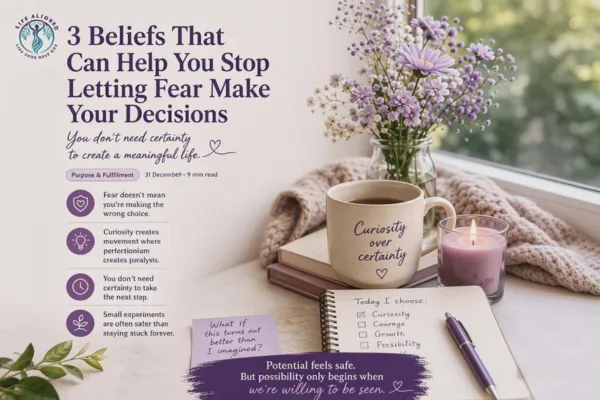
3 Beliefs That Can Help You Stop Letting Fear Make Your Decisions
Fear gets a bad reputation.
We're often told that confidence means not being afraid, that brave people simply push through, and that certainty should come before action.
But that's rarely how life works.
Most meaningful things come wrapped in uncertainty. New relationships. Career changes. Reinvention. Creative projects. Even learning to trust yourself again.
And for many women, fear doesn't travel alone.
It arrives hand in hand with guilt.
When life is already full, curiosity can feel frivolous. Exploring something new can feel selfish. Spending time on yourself can feel like time stolen from work, family, or the endless list of things that need doing.
Socuriosity gets pushed aside before it ever has a chance.
But perhaps fear isn't the problem.
Perhaps the problem is allowing fear to make all the decisions.
You don't have to eliminate fear. You simplyhave tostop handing it the steering wheel.
Key Takeaways
•Fear doesn't mean you're making the wrong choice.
•Curiosity creates movement where perfectionism creates paralysis.
•Guilt and time scarcity often silence curiosity before it begins.
•You don't need certainty to take the next step.
•Small experiments are often safer than staying stuck forever.
Table of Contents
•Introduction
•Why Fear Makes Sense
•Belief #1: Fear Doesn't Mean No
•Belief #2: Curiosity Is More Helpful Than Certainty
•Belief #3: You Don't Need Proof Before You Begin
•What If We Became Curious Together?
•FAQs
Featured Snippet Block
Quick Answer:
Shifting from fear to curiosity doesn't mean becoming fearless. It means replacing questions like, "What if this goes badly?" with more open questions that allow room for learning, growth, and possibility.
Introduction
Fear wants guarantees. Curiosity simply wants to see what might be possible.
If you've ever found yourself overthinking, waiting for certainty, or talking yourself out of something you deeply want, you're not alone.
Fear can be convincing.
It tells us we're being responsible.
Practical.
Realistic.
But sometimes what we're calling wisdom isactually self-protection.
Because uncertainty is uncomfortable.
And many of us have spent decades believing we should have things figured out before we act.
Add a full calendar, endless obligations, and the guilt that many women carry around prioritizing themselves, and curiosity doesn't stand much of a chance.
Exploring new ideas can feel indulgent.
Dreaming can feel irresponsible.
Trying something different can feel like stealing time from everyone else.
But perhaps there's another way.
Not through forcing confidence.
Not through pretending we're fearless.
But through becoming curious.
Here's what we'll cover.
Why Fear Makes Sense
Fear isn't proof that something is wrong. Often, it's proof that something matters.
So many women believe that fear means stop.
But fear is simply part of being human.
It exists to protect us.
And that's not a flaw.
In fact, it makes perfect sense.
When you're navigating midlife transitions, considering new possibilities, or questioning identities that have defined you for years, fear naturally appears.
Fear of making the wrong decision.
Fear of wasting time.
Fear of disappointing others.
Fear of looking foolish.
And because time feels scarce, curiosity itself can begin to feel like a luxury.
You may think:
"I don't have time to explore."
"There are more important things to do."
"I'll get to that later."
But later has a way of becoming years.
Most women believe fear means stop.
Often, fear simply means you're entering unfamiliar territory.
And unfamiliar doesn't automatically mean unsafe.
You don't need to fight fear. You simply need to stop treating it like the ultimate authority.
Takeaway: Fear isn't evidence that you're doing something wrong.
Belief #1: Fear Doesn't Mean No
Just because fear has an opinion doesn't mean it gets the final vote.
Many of us have learned to interpret fear as truth.
If we feel afraid, we assume we're making a mistake.
But feelings aren't instructions.
They're information.
Fear may be telling you:
"This matters."
"This is unfamiliar."
"This feels vulnerable."
Those messages are very different from:
"Don't do it."
There is a difference between danger and discomfort.
Discomfort often accompanies growth.
Starting something new.
Setting boundaries.
Changing careers.
Leaving relationships.
Writing books.
Speaking up.
Being seen.
None of these things are comfortable.
But discomfort doesn't automatically mean you're headed in the wrong direction.
Most people wait for fear to disappear before they act.
But courage isn't the absence of fear.
It's learning that fear can come along for the ride without sitting in the driver's seat.
Fear deserves compassion, not control.
Takeaway: Fear can have a voice without having the final vote.
Belief #2: Curiosity Is More Helpful Than Certainty
Curiosity asks less of you than certainty does.
For years, I believed I needed answers beforetaking action.
I wanted guarantees.
Proof.
Confidence.
But certainty is a standard that life rarely offers.
And perhaps that's good news.
Because curiosity asks much less.
Instead of:
"What if I fail?"
Curiosity asks:
"What if I learn something?"
Instead of:
"What if this is the wrong decision?"
Curiosity asks:
"What if I discover something I didn't know?"
Instead of:
"What if I embarrass myself?"
Curiosity asks:
"What if this turns out better than I imagined?"
And yet, curiosity can feel surprisingly difficult.
Not because we're incapable of it.
But because many women have learned to see exploration as unnecessary.
When time feels scarce, curiosity feels selfish.
When life is busy, wonder gets pushed aside.
Family comes first.
Work comes first.
Everyone else comes first.
And eventually, we stop asking questions altogether.
But perhaps curiosity isn't frivolous.
Perhaps it's essential.
Because confidence rarely comes before experience.
Confidence often grows because of experience.
You don't need certainty to take a step. You only need enough curiosity to wonder what might happen if you did.
Takeaway: Curiosity creates movement where perfectionism creates paralysis.
Belief #3: You Don't Need Proof Before You Begin
Potential feels safe. Vulnerability creates possibility.
Last year, I finished writing a book calledRemembering Forward.
And honestly, that felt like a huge accomplishment.
I could proudly say:
"I'm writing a book."
And eventually:
"I wrote a book."
People would naturally ask where they could find it.
And I had an answer.
I was waiting on my ISBN.
Then January came, and I finally applied for one.
It took a while.
Which gave me another answer.
"I'm just waiting on the ISBN."
And then April arrived.
The ISBN came through.
And suddenly, all my excuses disappeared.
Except one.
Fear.
What if I published it and nobody bought it?
What if no one cared?
What if all this hope and optimism turned into proof that I had failed?
In the meantime, I wrote another book.
A leadership book.
Because being someone who has written two books soundspretty impressive.
It's full of possibility.
Hope.
Potential.
But publishing?
Publishing means being seen.
Publishing means criticism.
Publishing means uncertainty.
And perhaps that's why unrealized dreams feel so safe.
As long as they stay hidden, they remain perfect.
Untouched.
Protected.
But they also remain unable to help anyone.
And eventually, I realized something.
If my books stay on my computer, no one can reject them.
But no one can be helped by them either.
And helping people was the reason I wrote them in the first place.
Nothing can fly if it never leaves the nest.
Protecting your potential may keep you safe, but it can also keep you hidden.
Takeaway: Possibility begins when we're willing to let our dreams be seen.
What If We Became Curious Together?
You don't have to know how the story ends to turn the page.
By the end of this month, I'm publishingRemembering Forward.
Not because the fear has disappeared.
It hasn't.
Not because I suddenly have guarantees.
I don't.
And not because I'm certain everyone will love it.
They won't.
But curiosity has finally become louder than fear.
Because what if people do need these words?
What if someone sees herself in the pages and realizes she's not alone?
What if one woman remembers that she's not broken?
What if this book helps someone come home to herself?
I don't know.
And perhaps I don't need to.
Because I know one thing for certain.
If it stays hidden on my computer, none of those possibilities can happen.
Solet's be curious together.
Let's stop waiting for certainty.
Let's stop demanding guarantees.
Let's stop allowing fear to decide everything.
Because staying safe guarantees very little.
It guarantees familiarity.
Sameness.
More of what already exists.
And maybe, just maybe, there is something beautiful waiting on the other side of the unknown.
Fear asks, "What if it goes wrong?" Curiosity asks, "What if it goes right?"
Takeaway: Possibility lives where certainty ends.
FAQs
How do I stop letting fear control my decisions?
You don't need to eliminate fear to stop being ruled by it.
Notice what fear is trying to protect, then ask a more curious question. Instead of demanding certainty, focus on exploration and learning.
Is fear a sign that I'm making the wrong choice?
Not necessarily.
Fear often appears whenever something meaningful or unfamiliar is involved. Feeling afraid doesn't automatically mean you should stop.
Why do I feel guilty about exploring new possibilities?
Because many women have been taught that everyone else's needs should come first.
When time feels scarce, curiosity can seem selfish. But making room for yourself and your growth isn't frivolous. It's part of being fully alive.
How can I become more curious instead of anxious?
Replace certainty questions with possibility questions.
Ask:
•What might I learn?
•What if this helps someone?
•What if this is only the beginning?
•What if I don't need all the answers right now?
What if I fail?
Failure is rarely the end of the story.
More often, it's information.
Trying something and discovering it isn't right for you isn't failure.
It's clarity.
And clarity is valuable.
What You Should Do Now
Perhaps there's something you've been carrying quietly.
An idea.
A dream.
A conversation.
A possibility.
And perhaps fear has been convincing you to wait until you're certain.
But certainty isn't a requirement for beginning.
You don't have to feel fearless to take the next step. You simplyhave tobecome curious enough to see what might happen.
And if you'd like to join me in this season of choosing curiosity over certainty, keep an eye out forRemembering Forwardby Valerie Kinghorn on Amazon.
Publishing it is one of my own acts of stepping into the unknown.
And if you read it, I'd love for you to leave a review and let me know what you think.
Not because I'm fearless.
But because I believe possibility is always worth exploring.
After all, potential feels safe.
But possibility only begins when we're willing to be seen.