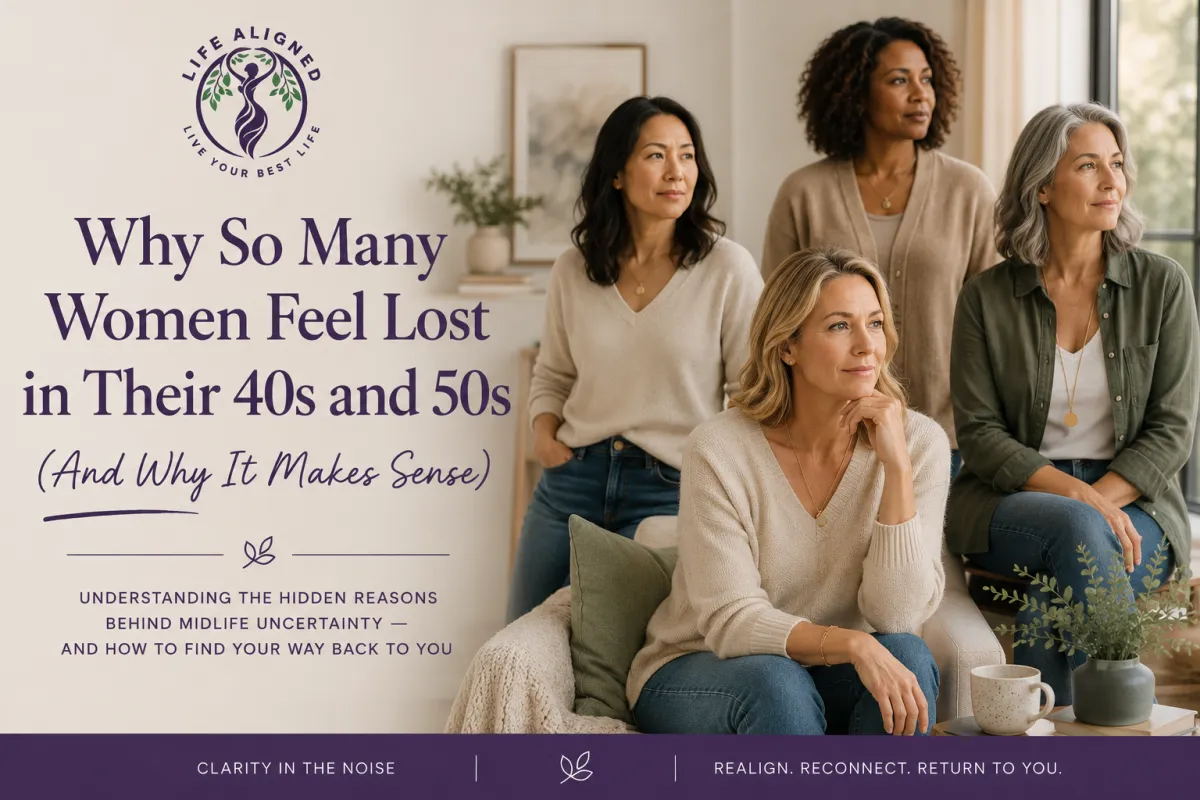
Is It Normal to Feel Lost in Your 40s or 50s?
Why So Many Women Feel Lost in Their 40s and 50s (And Why It Makes Sense)
There’s a quiet moment that catches many women off guard in midlife.
You’re looking at your calendar. Or standing in your kitchen. Or realizing your period arrived and you genuinely didn’t see it coming — not because you’re irresponsible, but because either your cycle has changed or your mind has been elsewhere.
And suddenly a thought lands:
How do I not have this together by now?
Your 40s and 50s were supposed to be the confident years. The settled years. The capable, competent, “I’ve figured it out” years.
Instead, you feel scattered. Questioning. Uncertain.
Here’s the truth: feeling lost in midlife is far more common than we talk about — and often far more reasonable than you think.
In this guide, we’ll explore:
Why midlife can feel destabilizing even when life looks stable
The invisible pressure cooker women carry in their 40s and 50s
How identity shifts and hormonal changes amplify uncertainty
Why self-judgement gets so loud during this season
What feeling lost might actually mean
Table of Contents
The Midlife Pressure Cooker No One Talks About
The Identity Shift Beneath the Surface
Hormones, Brain Fog, and the Loss of Predictability
Why the Self-Judgement Feels So Loud
What Feeling Lost Actually Means
FAQ: Feeling Lost in Your 40s and 50s
What You Should Do Now
Quick Answer
Yes, it is completely normal to feel lost in your 40s or 50s. Midlife often combines peak responsibility, identity shifts, hormonal changes, and cultural pressure — making disorientation a common and understandable experience.
Introduction
Midlife doesn’t mean you’re supposed to feel certain — it often means everything that once felt certain is shifting.
There’s a particular embarrassment that can come with feeling lost at this age.
You think:
“I’m too old for this.”
“I should have figured myself out by now.”
“Why does everyone else seem so steady?”
From the outside, you may look composed. Responsible. Capable. But inside, there’s a subtle unraveling.
Children are growing up or leaving. Careers plateau or intensify. Parents age. Bodies change. Hormones fluctuate. Energy shifts.
And no one really talks about how destabilising all of that can be — especially when you’re still expected to function at full capacity.
Here’s what we’ll explore: why feeling lost at midlife makes more sense than you’ve been led to believe.
The Midlife Pressure Cooker No One Talks About
Your 40s and 50s often carry more responsibility than any other stage of life.
Think about what you’re holding right now.
You may be:
Raising teenagers or young adults
Supporting aging parents
Leading teams or managing complex careers
Maintaining long-term partnerships
Managing a household
Carrying the invisible emotional labour for everyone around you
Research consistently shows that women in midlife often sit in the “sandwich generation” — caring both upward and downward simultaneously. Add career peak years to that, and you have one of the most responsibility-dense decades of adulthood.
And yet, culturally, this is when you’re expected to be your most stable.
Competent.
Clear.
Put together.
But here’s the contrast:
You’re being asked to operate at your highest level… during one of your most physiologically and emotionally complex seasons.
Feeling off inside a pressure cooker isn’t weakness — it’s human.
The Identity Shift Beneath the Surface
If you're wondering whether you're experiencing a life transition, identity shift, or emotional disconnection, the Reconnection Quiz can help you gain clarity.
Feeling lost is often identity recalibration, not collapse.
So much of identity in early adulthood is role-based.
Mother.
Partner.
Employee.
Caretaker.
High-achiever.
But midlife shifts those roles.
Children need you differently.
Careers evolve or stagnate.
Relationships stretch or strain.
Bodies change in ways that challenge self-image.
And when roles shift, identity wobbles.
You may find yourself asking:
Who am I when I’m not actively needed?
Who am I outside of what I produce?
Who am I becoming now?
This in-between stage can feel deeply uncomfortable.
You’re not who you were — but you’re not fully rooted in who you’re becoming.
And because most women don’t showcase their frazzled, scattered, uncertain moments, it can feel like you’re the only one in this liminal space.
You’re not behind. You’re between.
Signs You've Lost Yourself in Marriage, Motherhood, or Career
Hormones, Brain Fog, and the Loss of Predictability
When your body changes, your sense of control can quietly unravel.
Perimenopause alone can introduce:
Irregular cycles
Mood fluctuations
Brain fog
Sleep disruption
Heightened anxiety
Emotional sensitivity
You might suddenly be caught off guard by your period.
Was it irregular?
Did you lose track of time?
Is your body shifting faster than your mind can keep up?
Often, it’s a bit of both.
Hormonal fluctuations impact cognition, emotional regulation, and memory. Studies show oestrogen fluctuations can affect neurotransmitters tied to mood and focus.
So if you feel more scattered, more forgetful, more emotionally reactive — it isn’t a character flaw.
It’s biology layered on top of already high responsibility.
When predictability decreases, self-trust can wobble.
And that wobble can feel like:
“I’m losing it.”
But you’re not losing it.
Your body is transitioning. And transitions require recalibration.
Biology can amplify identity questioning — and that doesn’t make you incompetent.
Why the Self-Judgement Feels So Loud
The expectation that you “should have it together by now” is one of midlife’s cruelest myths.
Somewhere along the way, we absorbed a timeline:
20s = figuring it out
30s = building
40s+ = certainty
But real life doesn’t follow that script.
In fact, developmental psychology suggests midlife is often a stage of meaning re-evaluation — not consolidation.
Add comparison culture to that, and the judgement intensifies.
You see polished careers. Tidy homes. Confident social posts.
You don’t see:
The brain fog.
The quiet grief.
The late-night doubt.
The hormonal tears.
So you turn inward and think:
“What’s wrong with me?”
Nothing.
You’re navigating:
Peak pressure
Identity shift
Hormonal transition
And decades of internalised performance standards
Of course self-criticism gets loud.
It’s trying to regain control.
The shame isn’t proof you’re failing — it’s proof you care deeply about doing life well.
What Feeling Lost Actually Means
Lost doesn’t mean you’ve ruined your life — it often means you’ve outgrown a version of it.
Feeling lost in your 40s or 50s rarely means:
You made the wrong choices
You wasted your life
You missed your chance
More often, it means:
You’re recalibrating identity
You’re shedding outdated expectations
You’re feeling the weight of long-term responsibility
You’re biologically transitioning
You’re craving alignment instead of performance
This isn’t regression.
It’s threshold.
And thresholds feel disorienting before they feel empowering.
You don’t need a dramatic reinvention.
You need orientation.
Many women discover that feeling lost isn't about failure—it's about becoming disconnected from who they are today. You may also find our article Why Do I Feel Disconnected From My Life? helpful.
FAQ: Feeling Lost in Your 40s and 50s
Is it common to feel lost in your 40s or 50s?
Yes. Many women experience identity questioning, hormonal shifts, and meaning re-evaluation during midlife. Feeling lost is far more common than most people admit publicly.
Is feeling lost a sign of depression?
Sometimes it can overlap, but not always. Midlife disorientation can stem from transition, burnout, or identity shifts. If symptoms are severe or persistent, professional support is important.
Does perimenopause make you feel emotionally unstable?
Hormonal fluctuations during perimenopause can affect mood, memory, and stress tolerance. This can amplify feelings of uncertainty or loss of control.
Why does it feel like everyone else has it together?
Most people present curated versions of their lives. Very few share their confused, frazzled, or uncertain moments publicly.
Is it too late to change direction in midlife?
No. Many women begin new careers, relationships, creative paths, and personal chapters in their 40s and 50s. Midlife is not an ending — it’s often a pivot point.
What You Should Do Now
If you’re feeling lost, you don’t need to shame yourself into clarity.
You don’t need to overhaul your life this week.
But you do deserve language for what’s happening.
I created a gentle quiz called:
Why Do I Feel Off—Even When My Life Looks Fine?
It’s designed to help you name what’s really going on beneath the surface — whether you’re navigating disconnection, misalignment, or transition.
Based on your answers, you’ll receive personalised guidance and free resources tailored to your current season.
No pressure. No diagnosis. Just clarity.
You can take the quiz here:
https://lifealigned.vip/reconnectionquiz
You’re not immature.
You’re not behind.
And you’re certainly not the only one.
You’re in a season of becoming.